
Focusun Tube Ice Machine
Focusun supplies 1-50T tube ice machines with hygienic SUS304 parts, Bitzer components and custom ice sizes. Send your capacity needs today.
View productMost ice projects are decided before the purchase order exists — in the questions a buyer forgot to ask. This guide gives you the same eight screening checks for any ice machine supplier, a repeatable way to convert daily tonnage into a capacity band, and a line-by-line method for reading a quotation instead of just comparing totals. It also sets out how flake ice machine manufacturers differ from trading houses on fabrication, run testing and spare-parts stock, so the shortlist you take to your finance team stands on more than price.
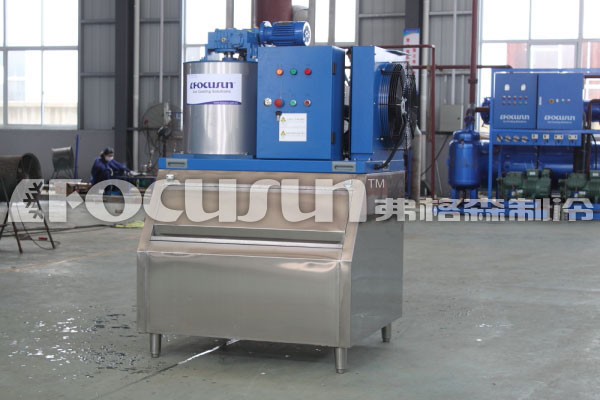
Eight questions do most of the screening work, and none of them require a factory visit. Send them in writing before you exchange prices. The answers either confirm you are dealing with a plant that builds, tests and supports its own machines — or explain why two offers are not really comparable at all.
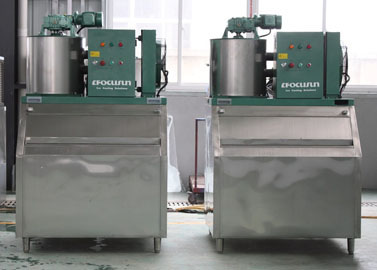
Good answer: a named workshop, plus photos or video of the drum and scraper assembly being built.
Red flag: “we buy the ice maker and build the frame around it.”
Good answer: a scheduled run test at rated capacity, with the serial plate in frame if you cannot attend.
Red flag: catalogue photos only — nothing available to run.
Good answer: two or three references in your tonnage band and your application, with contact details.
Red flag: every customer is described as confidential.
Good answer: a stock list of consumables and wear parts with typical dispatch times.
Red flag: every part is ordered from abroad after a breakdown.
Good answer: the supplier issues the commercial invoice, packing list, certificate of origin and shipping documents for your port.
Red flag: paperwork is left to your forwarder after payment.
Good answer: a named engineer reviews ambient conditions, power supply, water source and layout before the price is fixed.
Red flag: “sales will confirm the spec after the order.”
Good answer: the manufacturer issues it in its own name and names the party that performs the service.
Red flag: “we pass on whatever the factory gives us.”
Good answer: compressor make and model, refrigerant, control panel brand and a key component list attached to the offer.
Red flag: “international brand components,” with no list.
Two numbers decide the plant: total tons per 24 hours and the busiest hour of the day. Suppliers quote in tons per 24 hours, but your operation succeeds or fails on peak draw — so send both figures, every time.
Store-level food preservation and smaller processing rooms with steady daily demand.
Meat and food processing, aquatic product processing, aquaculture facilities and cold-chain distribution.
High-volume processing plants, chemical production and large cold stores.
Coastal plants and vessels fed by seawater — the same machine is built for land and marine use.
A processing hall packs four tonnes a day, and 1.2 tonnes of that moves in the single hour after the boats land.
Production capacity is customizable on this range, so a tonnage that falls between the tiers is not a problem — but it has to be stated clearly. See the full flake ice machine specification.

A quotation is a specification document, not a price tag. Nine lines separate an offer you can compare against another offer from one you have to interpret, phone about and eventually take on trust.
| Line item | Thin quote | Complete quote |
|---|---|---|
| Compressor | “Imported compressor” | Brand and model stated (Copeland), with quantity per circuit |
| Refrigerant | Not mentioned | R404A, with charge quantity and circuit details |
| Power supply | “380V” | 380V, 3 phase, 50Hz, with total connected load |
| Control panel | “PLC control” | Panel make, control logic, alarm list, interface language |
| Spare parts | None listed | Recommended first-year spares with unit prices and dispatch time |
| Warranty | One line, no owner named | Term, what is covered, and who performs the service |
| Incoterms | “FOB” | Named Incoterm, named port, packing and container type |
| Lead time | A single number of days | Ready date, documentation time and shipping window separately |
| Commissioning | Not in scope | Supervision days, who travels, who pays, and what the handover covers |
If you can attend the run test, bring this list. If you cannot, ask for the same items as video with the serial plate in frame — a short clip of a machine starting up tells you far less than a full run.

Two offers that look far apart on price can reverse within a few years. Compare the plants on the cost of every ton of ice they produce, and ask each supplier for the same five numbers in writing.
Ask for the expected power consumption per ton at your ambient condition. Without that figure, running cost is guesswork.
How often service is due, who performs it, and what a visit costs. Cleaning and servicing should be a planned task, not a rebuild.
A machine built on readily available international brand components — the reason this range uses Copeland compressors and air cooling — keeps you out of a single-channel parts trap.
Put a value on one lost production day. A lower price with a long parts lead time is rarely the cheaper machine.
A containerized unit can be moved rather than rebuilt, which changes the value of the asset at the end of a site’s life.
Energy, water, service and spares divided by annual tonnage is the only number that compares fairly across suppliers.

How the plant travels decides your installation cost — and sometimes whether the project is possible on the site you have.

The application decides which tier and which ice form you should be pricing. Use the table below to move from your site description to the exact questions you put to a supplier.
| Scenario | Capacity anchor | Specify before you quote | Buyer decision |
|---|---|---|---|
| Supermarket food preservation | Small capacity, 0.5 – 3 t/24h | Store power supply, drainage and the airflow path around an air-cooled unit | Ice kept loose or bagged on site |
| Meat and food processing hall | Medium capacity, 5 – 20 t/24h | Peak-hour demand, maximum summer ambient, position of the ice discharge | Size of buffer storage between plant and line |
| Aquatic product processing and landing | Medium to large, 5 – 60 t/24h | Flake size for product contact, water quality, whether fresh or seawater feed is available | Fresh-water unit or seawater type |
| Aquaculture facility | Medium capacity band | Daily tonnage, how ice is transported to the tanks or ponds | Fixed plant or relocatable containerized build |
| Chemical production | Large capacity, 25 – 60 t/24h | Process temperature requirement and duty cycle, not just daily tonnage | Whether a second unit is needed for continuity |
| Cold chain, storage, transport and temporary sites | Containerized, 20ft or 40ft | Container type, destination port and power available at the temporary site | Relocatable plant or permanent installation |
| Vessel or coastal plant | Seawater type, 0.8 – 6 t/24h | Seawater feed conditions and whether the unit operates at sea or on land | Marine installation or shore-based plant |
Capacity is settled in the sizing step above. The table below lists the build details that should appear identically across the offers you shortlist — if they differ, you are not comparing the same machine.
| Flake size | Irregular flakes, approximately 40 mm × 40 mm |
| Flake thickness | Approximately 1.5 – 2.5 mm |
| Cooling method | Air cooling |
| Compressor | Copeland, with other international brand components |
| Power supply | 380V, 3 phase, 50Hz |
| Refrigerant | R404A |
| Container models | 20-foot and 40-foot standard containers |
| Capacity | Customizable to your required production figures |

Suppliers price what you describe. The list below is what a selection engineer needs in order to size a plant, commit to a delivery window and stand behind the figure.
If your tonnage sits between catalogue tiers, say so — production capacity is customizable, and a clear figure is what makes the offer precise.
Keep adjacent product options together for a faster catalog comparison.
Focusun supplies 1-50T tube ice machines with hygienic SUS304 parts, Bitzer components and custom ice sizes. Send your capacity needs today.
View product
Focusun Block Ice Machine features Siemens PLC controls and titanium evaporators. As a reliable ice machine supplier, we offer scalable, modular cooling.
View product
For fishery and food processing application, Focusun has come out with different types of plate ice machines which can meet every client's requirements.
View productthe brand and model, stated by name, with the quantity per circuit. an imported compressor on its own is the thin-quote example the comparison table uses.
the refrigerant designation, its charge quantity and the circuit details. R404A is the reference in the table, and a quote that leaves the refrigerant unmentioned is incomplete.
voltage, phase and frequency together with the total connected load. 380V three phase 50Hz is the example, but the connected load is what sizes the supply.
the panel make, the control logic, the alarm list and the interface language. PLC control written without those four points is not a specification.
because first-year spares with unit prices and dispatch time, plus a warranty that names who performs the service, decide the real cost of ownership. a one-line warranty with no owner is a flagged weakness.
line by line against the same eight checks, not by total price. the table sets a thin quote beside a complete quote for each line item so the missing fields stay visible.